Dichosity: The Word That Isn’t in Any Dictionary But Shows Up Everywhere
Here is something odd. You can find dozens of websites explaining “dichosity” in detail. Long articles. FAQs. Big guides. But search Merriam-Webster, Cambridge, or Oxford? Nothing. Not a single entry. That alone tells you something important about this word — and about the internet in 2026.
Quick Reference
| Factor | Detail |
|---|---|
| Word Type | Noun (claimed) |
| In Major Dictionaries? | No |
| Related Real Word | Dichotomy |
| Greek Root | “Dicha” — meaning “in two” |
| First Web Appearances | Early 2026 |
| Used In | Philosophy, psychology, business content |
| Contested? | Yes — origin and legitimacy unclear |
What Does Dichosity Actually Mean?
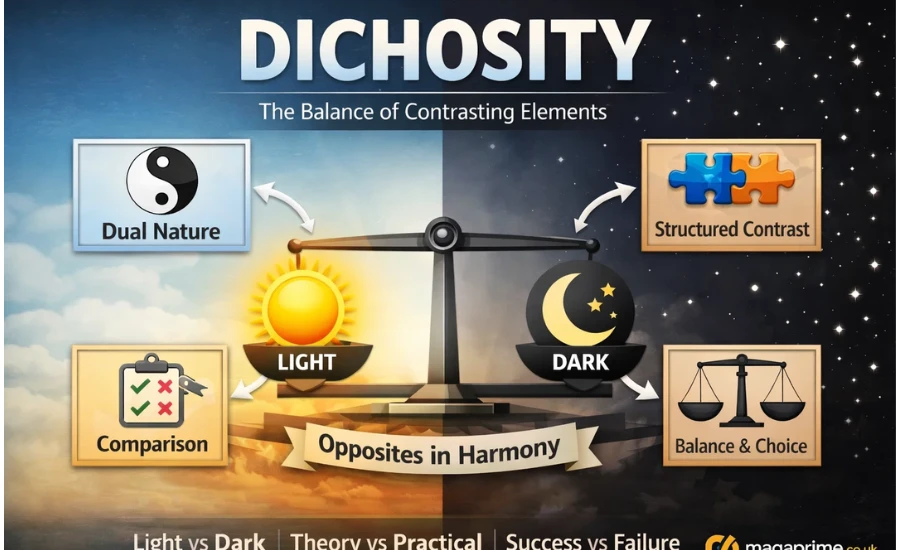
The short version: it describes something split into two contrasting parts — but where those two parts still connect or work together. Think hot and cold. Logic and emotion. Work and rest. Not enemies. Just opposites sharing the same space.
Dichosity differs from dichotomy in one key way. Dichotomy focuses on the act of dividing. Dichosity focuses on the state of being divided — the condition of having a dual nature. That is a subtle gap. But it matters.
The idea is that two opposing things do not have to destroy each other. They can both exist. They can even need each other. Light means nothing without dark. Risk means nothing without safety.
Where Did This Word Come From?
The Greek root “dicha” means “in two” or “apart.” That root is real and old. It gave us dichotomy, dichotomous, and dichotic — all words you will find in proper dictionaries. But “dichosity” as a standalone word? No academic paper uses it. No philosopher coined it. No linguist on record built it.
The structure of the word suggests someone added “-osity” to “dicho-” — the same way we get “verbosity” from “verbose.” That is a grammatically valid move in English. But valid word construction does not equal accepted meaning. Anyone can build a word. Not everyone earns a dictionary entry.
Dichosity vs Dichotomy: What Is The Real Difference?
This is where most articles get fuzzy. Here is what the sources say, cut down to what actually holds up.
Dichotomy: a clean split. Two parts. Done. You pick one side or the other. It is about the act of dividing.
Dichosity: the condition of living with that split. Both sides exist at once. Neither cancels the other. It is about the state of being divided while still functioning as one thing.
Think of a business. It wants profit. It also wants to help people. Those two goals pull in different directions. A dichotomy would say: pick one. Dichosity says: hold both, manage both, accept both.
One is a knife. The other is a balancing act.
What Fields Use This Concept?

Even if the word itself is shaky, the idea behind it shows up in real disciplines.
Psychology: Researchers have long studied what happens when people think in strict either-or terms. Clinical studies link rigid binary thinking to anxiety, depression, and certain personality disorders. The mind that cannot hold two ideas at once tends to struggle more. Dichosity, as a concept, pushes back against that rigidity.
Philosophy: Ancient Greek thinkers spent centuries mapping opposing forces — good and evil, order and chaos, mind and body. The Council of Constantinople in 869 even ruled on how to split body and soul. These debates were early versions of what dichosity tries to name.
Science: Matter and energy. Classical and quantum physics. Organic and inorganic chemistry. Science runs on pairs. Every experiment has a control and a variable. Dichosity names that structure without requiring you to kill one side of the pair.
Business: Leaders face this constantly. Short-term profits vs long-term growth. Innovation vs stability. Profit vs social responsibility. Good strategy holds both sides in view at the same time. That is dichosity in action, even if nobody in a boardroom calls it that.
Language: Words get meaning from contrast. “Hot” only works because “cold” exists. “Fast” needs “slow.” Language itself is built on pairs. Storytelling uses hero and villain. Debate uses thesis and antithesis. Dichosity is the structure under all of it.
The Dangers of Getting This Wrong
Here is what nobody talks about. Dichosity can become a trap if used poorly.
Forcing everything into two categories is a mistake. Real life has more than two options most of the time. Someone who only sees risk vs safety misses the space in between — calculated risk, managed uncertainty, partial commitment.
Psychologists call this “false dichotomy.” You present two choices as if they are the only two. They are not. A political candidate frames immigration as “open borders or total shutdown.” Neither extreme is the full picture. That is a false dichosity — a manufactured split used to control how people think.
Oversimplification is a real cost. Binary thinking speeds up decisions. But speed and accuracy are not the same thing. Quick choices based on two-option thinking miss the gray zone where most real answers live.
Also: holding two opposing ideas requires mental effort. Not everyone is trained for it. Organizations that push dichotic thinking without support for the discomfort it creates often see more conflict, not less.
Types of Dichosity
Dichosity shows up in different forms depending on where you look.
Intellectual dichosity covers opposing ideas or beliefs — truth vs illusion, freedom vs control, reality vs perception.
Emotional dichosity covers conflicting feelings — love and resentment toward the same person, pride and shame about the same choice.
Social dichosity covers group-level tensions — tradition vs modernization, individual needs vs collective good, rich vs poor.
Moral dichosity covers ethical clashes — justice vs mercy, honesty vs sensitivity, duty vs desire.
Technological dichosity is perhaps the clearest modern example. Technology connects people across the globe while also isolating them inside screens. It gives individuals enormous power while raising serious concerns about surveillance and control. The same tool does both at once.
Real-World Examples That Actually Make Sense
A doctor must tell a patient hard news. Honesty requires saying the truth. Compassion requires saying it without causing unnecessary pain. That is dichosity. Both values are real. Both pull in different directions. Good medicine holds them both.
A student fails an exam. Strict evaluation says: you did not reach the standard. Supportive education says: you have room to grow. A good teacher holds both responses. The grade is honest. The conversation is encouraging.
A parent sets a rule for a child. The rule is firm. The relationship remains warm. Discipline and love working together — that is dichosity in family life.
A government balances privacy and security. More surveillance catches more criminals. But it also watches innocent people. Neither value disappears. Neither wins completely. Good policy manages both.
What No One Tells You About “Dichotic” vs “Dichosity”
There is an existing, established scientific term: dichotic. It appears in real psychology and neuroscience. Dichotic listening tests — used since the 1950s — present different audio to each ear separately to study how the brain processes competing information. That word has peer-reviewed research behind it.
Dichosity does not. This matters. The word “dichotic” is in scientific literature with traceable origins and proper citations. “Dichosity” is in content websites with no citations at all. That gap is significant. One has academic weight. The other has web traffic.
How To Actually Use Dichotic Thinking

If the concept has value — and it does, even if the word is debated — here is how to apply it.
When facing a hard decision, resist the first instinct to pick a side. Ask what each side is protecting. Understand why both options exist before eliminating one. Look for approaches that keep both values alive instead of sacrificing one entirely.
In conflict, stop asking who is right. Ask what each side needs. Most real disputes are not about facts. They are about two competing needs that both have some legitimacy.
In creative work, use tension productively. The best stories hold opposing forces in unresolved tension. The character wants freedom. The character also wants belonging. That pull is what makes the story real.
In science, resist premature conclusions. Data often points two directions at once. Living with that ambiguity until the evidence gets clearer is better than forcing an early answer.
You may also like Wixnets.com
FAQ
1. What does dichosity mean in simple terms?
It refers to the condition of having two opposing or contrasting elements that exist together within the same system, idea, or situation — without one side destroying the other.
2. Is dichosity a real word?
It is used widely online, but it does not appear in any major dictionary as of 2026. The word is structurally valid in English but lacks formal linguistic or academic recognition.
3. What is the difference between dichosity and dichotomy?
Dichotomy describes the act of splitting something into two parts. Dichosity describes the condition or state of existing in that split — the ongoing experience of holding two opposing sides at once.
4. Where does the word come from?
It appears to be built from the Greek root “dicha,” meaning “in two.” The suffix “-osity” suggests a quality or condition. No single person or publication is on record as having coined the term.
5. Is dichosity the same as dualism?
Not exactly. Dualism is a broad philosophical idea about fundamental opposites — mind and body, good and evil. Dichosity is more practical. It focuses on contrasts as they appear in everyday decisions, systems, and relationships.
6. Can dichosity be harmful?
Yes. When overused or applied too rigidly, it reduces complex situations to only two choices, which can miss important middle-ground options and reinforce bias or conflict.
7. How does dichosity relate to psychology?
Research on dichotomous thinking shows that seeing the world in strict binary terms is linked to certain personality disorders and cognitive distortions like anxiety and depression. Dichosity, as an alternative framework, encourages holding both sides without forcing a premature resolution.
8. What is a false dichosity?
When a situation is presented as having only two options when in fact more exist. Politicians, advertisers, and media often use false dichotomies to limit how people think about an issue.
9. How is dichosity used in business?
Leaders use it to hold competing priorities at once — growth and stability, innovation and risk management, profit and ethics. It is a way of thinking about trade-offs without abandoning either value entirely.
10. Does dichosity appear in science?
The concept appears in how science organizes knowledge — matter vs energy, classical vs quantum, organic vs inorganic. But the word “dichosity” itself does not appear in scientific literature. The related word “dichotic” does, and has decades of research behind it.
11. Is dichosity the same as “both-and” thinking?
Very close. “Both-and” thinking is a recognized concept in leadership and philosophy that rejects either-or framing. Dichosity, as described online, is essentially the same idea with a different label.
12. Why do so many websites have articles about dichosity?
Most of those articles appeared in early 2026 in a short period of time. They follow the same structure, use the same examples, and target similar search terms. This pattern is consistent with content created to rank in search engines rather than to inform readers about an established concept.