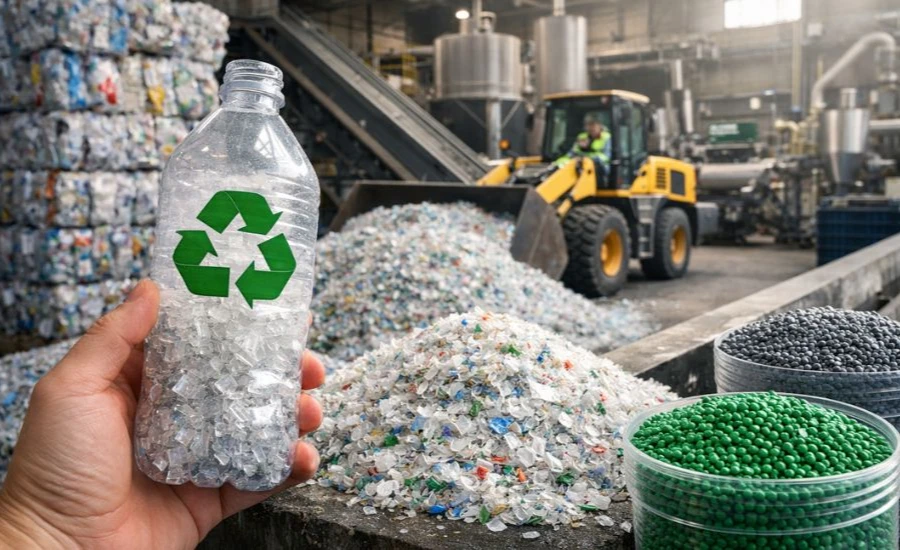
Recyclatanteil: A German Term That Is Now EU Law.
Recyclatanteil, In 2019, the OECD measured how much plastic waste globally was actually being recycled. The answer was 9 percent.
The EU has set a target of 50 percent plastic recycling by 2025.
The gap between those two numbers is the entire story of Recyclatanteil. Not the definition. Not the formula. Not the feel-good language about circular economies. The gap.
Recyclatanteil is the German term for recycled content share — the percentage of a product made from recycled material rather than newly extracted raw material. It is now the subject of a binding EU regulation that entered into force in February 2025. Companies that sell packaging in the EU have deadlines running from August 2026 through January 2030 and beyond. Those that miss targets face bans from the EU market and fines potentially reaching 4 percent of their annual turnover.
That is not a suggestion. That is law.
Most articles explaining Recyclatanteil were written by AI and contain no regulation numbers, no actual percentages, no certification names, and no honest account of how far current industry practice sits from where the law now requires it to be.
This article goes through what is actually in the regulation, what the certification standards require, and where the real contradictions lie.
Quick Reference
| Detail | Information |
|---|---|
| Term origin | German: “Recyclat” (recyclate) + “Anteil” (share/portion) |
| English translation | Recycled content share |
| Core definition | Percentage of recycled material in a product by mass |
| Formula | (Mass of recycled material ÷ Total product mass) × 100 |
| International standard | ISO 14021 — Environmental labels and declarations: self-declared environmental claims |
| Two recyclate types | PCR (Post-Consumer Recyclate) and PIR (Pre-Industrial/Post-Industrial Recyclate) |
| Governing EU regulation | PPWR — Packaging and Packaging Waste Regulation (EU) 2025/40 |
| PPWR in force | February 11, 2025 |
| PPWR general application | August 12, 2026 |
| First major targets | January 1, 2030 |
| Key 2030 target (PET) | 30% PCR content minimum for contact-sensitive PET packaging |
| Key 2030 target (other plastics) | 7.5% PCR content minimum for other contact-sensitive plastic packaging |
| Key 2030 target (general) | Up to 35% for most plastic packaging (category-dependent) |
| Certification standards | EN 15343; ISCC PLUS (for chemical recycling) |
| Global plastic recycling rate (2019) | 9% — OECD Global Plastics Outlook |
| Penalty for non-compliance | Up to 4% of annual turnover; potential EU market ban |
The Definition — Simple, The Measurement — Not
The definition of Recyclatanteil is genuinely simple. Take the weight of recycled material in a product. Divide it by the product’s total weight. Multiply by 100. You have the Recyclatanteil percentage.
A plastic bottle weighing 100 grams that contains 40 grams of recycled plastic has a Recyclatanteil of 40 percent.
The measurement, however, is where things get complicated. And the complication matters for two reasons: companies want to count as much as possible, and regulators want to count only what is genuinely recycled. Those two interests are not the same.
ISO 14021 — the international standard governing recycled content claims — defines two distinct types of material.
Post-Consumer Recyclate (PCR): Material collected from households, businesses, or other end users after a product has served its purpose. Old plastic bottles, used packaging, collected consumer waste. This is the most environmentally valuable form of recycled content. It closes the actual waste loop. It requires functioning collection systems, sorting infrastructure, and reprocessing capacity.
Pre-Industrial Recyclate (PIR), also called Post-Industrial Recyclate: Manufacturing waste generated during production processes. Trimmings, offcuts, defective parts that never reached a consumer. This is reused within the industrial supply chain. It reduces waste at the production stage but does not address the problem of consumer waste sitting in landfills or oceans.
The EU’s PPWR specifically targets Post-Consumer Recyclate. The regulation’s language says PCR from “post-consumer plastic waste.” Companies that have been padding their Recyclatanteil figures with PIR — which is easier to source and track — will find that it no longer satisfies the regulatory threshold.
This distinction is one of the most important in the entire sustainability debate around packaging, and it is absent from almost every general-audience article explaining Recyclatanteil.
The Regulation — What The Numbers Actually Say
The EU Packaging and Packaging Waste Regulation (EU) 2025/40, known as the PPWR, entered into force on February 11, 2025. It generally applies from August 12, 2026, with the major recycled content targets kicking in from January 1, 2030.
Here is what the regulation actually requires for plastic packaging from 2030:
30 percent PCR content minimum for contact-sensitive packaging made primarily from polyethylene terephthalate — PET — the plastic most commonly used in drinks bottles and food trays. This excludes single-use beverage bottles, which have separate targets.
7.5 percent PCR content minimum for other contact-sensitive plastic packaging not made from PET. This category — which covers a wide range of food-grade plastics including HDPE, PP, and others — has the lowest mandatory threshold.
These two numbers come directly from the European Parliament legislative text. A third number — 35 percent — appears in other sources including Cosmeservice, which describes this as the target for “most plastic packaging” by 2030. The PPWR does include higher targets for non-contact-sensitive plastic packaging categories, which is where the 35 percent figure originates.
The different percentages apply to different packaging categories. Articles that state “35 percent for all plastic by 2030” are oversimplifying. Articles that cite only “7.5 percent” are describing the lowest threshold, not the general rule. Both claims can be found in the public record. Neither is wrong in isolation. Together, they paint an incomplete picture.
The key dates beyond 2030:
By January 2035: recyclability must be demonstrated in practice at industrial scale. By January 2038: only packaging with recyclability grade A or B may be marketed — A representing 95 percent or more recyclable content, B representing 80 percent or more.
A product that does not meet the Recyclatanteil thresholds cannot legally be placed on the EU market after the relevant deadline. This is not a labelling requirement. It is a market access requirement.
The Mass Balance Problem — How Companies Can Claim High Recyclatanteil Without Using Recycled Plastic
This is the most important and most underreported issue in the entire Recyclatanteil debate.
Chemical recycling is an emerging technology that breaks down plastic polymers into feedstocks that can be used to make new plastic. Unlike mechanical recycling — which physically melts and reshapes plastic — chemical recycling works at the molecular level. It can handle mixed or contaminated plastics that mechanical recycling cannot process.
However, chemical recycling plants do not produce discrete batches of recycled material that can be physically tracked into specific products. Instead, they use a “mass balance” accounting approach. Under mass balance, recycled feedstock inputs are tracked through a certification chain and allocated to products — but the actual molecules in a given product may or may not be from recycled sources. The recycled content is a book allocation, not a physical trace.
The ISCC PLUS certification — mandatory for companies using chemical recycling and the mass balance approach — is designed to ensure that the reported volumes of recycled feedstock correspond to actual certified sustainable inputs. This prevents double-counting. But critics argue that mass balance allows virgin plastic to be sold as having high recyclatanteil as long as recycled inputs somewhere in the production chain match the claimed volumes.
Whether mass balance constitutes genuine Recyclatanteil or sophisticated greenwashing is one of the most live debates in European packaging regulation. The PPWR’s delegated acts — still being developed — will need to clarify the rules on this. Until they do, the uncertainty creates space for companies to make recycled content claims that look identical on paper but represent very different realities.
The Greenwashing Gap — Claiming vs. Certifying
ISO 14021 allows companies to make self-declared environmental claims about recycled content. “Self-declared” means no independent verification is required to make the claim.
This is where the gap between marketing and reality opens up.
A company can print “made from 50% recycled materials” on its packaging without certification, as long as it has internal records to support the claim. Whether those records are accurate, whether the recycled content is PCR or PIR, and whether the supply chain certification is robust enough to withstand scrutiny are different questions.
The EN 15343 standard — specifically designed for recycled plastic tracing — provides a certification framework that goes beyond self-declaration. Companies seeking credible Recyclatanteil claims are increasingly expected to hold EN 15343 certification. The PPWR’s enforcement mechanisms will strengthen this expectation.
Peacequarters.com’s analysis notes plainly: “Your Recyclatanteil cannot just be self-declared; it must be audited and certified to avoid accusations of greenwashing from watchdogs as well as regulators and tax authorities.”
Fines for greenwashing — making environmental claims that cannot be substantiated — are separate from PPWR compliance fines. Both exposure paths exist simultaneously.
The Supply Problem Nobody Mentions in Positive Articles
Every article praising Recyclatanteil as a driver of the circular economy skips a structural problem: there is not enough high-quality recycled plastic available to meet the targets the regulation sets.
The OECD’s Global Plastics Outlook reported 9 percent of plastic globally was recycled in 2019. The EU is mandating minimum recycled content thresholds across packaging categories. The demand for Post-Consumer Recyclate is going to increase sharply as the 2030 deadlines approach. The supply of certified PCR is not increasing at the same rate.
This creates a market imbalance. Companies competing for a limited pool of certified PCR material will drive prices up. Smaller companies — specifically microenterprises, which are explicitly exempted from some PPWR obligations — face a different calculation than large manufacturers.
The regulation acknowledges this: the PPWR states that microenterprises are exempted from the minimum recycled content obligations if they fall within the standard definition of a microenterprise in a given calendar year.
But medium-sized manufacturers — not large enough to easily absorb cost increases, not small enough to qualify for exemptions — are the most exposed. This is not discussed in any general-audience article about Recyclatanteil.
What Industries Face The Biggest Challenges
The PPWR targets plastic packaging specifically for the first round of mandatory recycled content requirements. But Recyclatanteil is relevant across multiple industries.
Packaging: The primary target of the PPWR. The distinction between contact-sensitive and non-contact-sensitive packaging carries different thresholds. Food and pharmaceutical packaging — contact-sensitive categories — face regulatory scrutiny over what recycled content can legally be used near food or medicine.
Construction: Building materials such as insulation, pipes, and flooring can contain significant recycled content. This sector uses Recyclatanteil but is not currently under the same mandatory regulatory pressure as packaging.
Textiles: Recycled polyester from plastic bottles — marked as rPET — is common in clothing. The Recyclatanteil of a garment made from recycled plastic bottles is measurable and increasingly marketed. No EU mandatory recycled content floor exists for textiles in the same way as for packaging.
Electronics: Recycled metals and plastics in electronic components. Some categories face specific regulations. The general trend is toward higher recycled content requirements across the board.
Automotive: Car interiors, bumpers, and components increasingly incorporate recycled plastic. Automakers report Recyclatanteil for specific components in sustainability reports.
Recyclability vs. Recyclatanteil — The Distinction That Matters
These two terms are often confused or conflated in general-audience articles.
Recyclatanteil is what a product contains right now — the proportion of recycled material already in it.
Recyclability is what will happen to a product at the end of its life — whether it can be effectively collected, sorted, and reprocessed.
A product can have a high Recyclatanteil — made mostly from recycled material — and still be poorly recyclable at end of life because of how it is constructed.
A product can be highly recyclable — made from materials that the recycling system handles well — and still contain zero recycled content, because it was made from virgin materials that will be recycled later.
Both metrics matter for a functioning circular economy. Neither is sufficient on its own. The PPWR addresses both — recyclability grades for all packaging by 2030, and recycled content minimums for plastic packaging also by 2030.
Most consumer-facing articles describe only one or the other. The distinction is rarely explained.
The AI-Generated Article Problem — Same Pattern as Fontlu
The same issue documented in the Fontlu article appears here.
Phrases like “bridges the gap between creativity and accessibility” (for Fontlu) become “bridges the gap between sustainability goals and industrial reality” (for Recyclatanteil). The structure is identical. The vocabulary is swapped.
Multiple articles about Recyclatanteil use identical or near-identical sentences across different domains — trendycore.co.uk, city-robots.com, fillmoretownship.com, instrumentstogo.com — none of which have any evident expertise in environmental regulation. They explain the concept in general terms, use the same metaphors, cite no specific regulation text, and provide no actionable information.
The sources that contain real regulatory specifics — peacequarters.com, globleinsight.co.uk, the European Commission’s PPWR page, the European Parliament’s legislative text, Cosmeservice’s compliance briefing, Circularise’s PPWR guide — are harder to find and require more careful reading.
The gap between what is easily readable and what is actually accurate is a real problem for companies trying to understand their compliance obligations.
What Is Confirmed vs. What Is Claimed
Confirmed from primary regulation and international standards:
- PPWR (EU) 2025/40 in force February 11, 2025; applies August 12, 2026
- January 2030: minimum 30% PCR for contact-sensitive PET packaging
- January 2030: minimum 7.5% PCR for other contact-sensitive plastic packaging
- General plastic packaging: higher targets ranging toward 35% by category
- ISO 14021 governs self-declared recycled content claims
- PCR and PIR are distinct categories under ISO 14021; regulation targets PCR
- EN 15343 standard for recycled plastic tracing; ISCC PLUS for chemical recycling
- Penalties: up to 4% of turnover; EU market access can be denied
- OECD: only 9% of plastic globally was recycled in 2019
- Microenterprises are specifically exempted from recycled content obligations
Claimed but oversimplified in general-audience articles:
- “35% for all plastic packaging by 2030” — only accurate for specific non-contact packaging categories, not across the board
- “Companies can easily meet targets by switching suppliers” — the PCR supply shortage makes this difficult and expensive
- Recyclability and Recyclatanteil described as the same thing — they are not
Absent from almost every general-audience article:
- The PCR vs. PIR distinction and its regulatory significance
- The mass balance controversy and what it means for chemical recycling claims
- The supply shortage problem for certified PCR
- Specific certification names (EN 15343, ISCC PLUS)
- The microenterprise exemption
- The difference between recyclability grades (A through E) and recycled content thresholds
You may also like Fontlu
FAQ — 12 Real Questions
1. What does Recyclatanteil mean?
It is a German term — “Recyclat” (recyclate) plus “Anteil” (share) — meaning recycled content share. It refers to the percentage of a product made from recycled material rather than virgin raw material, measured by mass.
2. How is it calculated?
(Mass of recycled material ÷ Total product mass) × 100. A 100-gram bottle containing 40 grams of recycled plastic has a Recyclatanteil of 40 percent.
3. What is the difference between PCR and PIR?
Post-Consumer Recyclate (PCR) comes from products after consumers have used them — household packaging, used bottles. Pre-Industrial Recyclate (PIR) comes from manufacturing waste — factory offcuts that never reached a consumer. The EU’s PPWR targets PCR specifically. PIR is less valuable environmentally because it does not close the consumer waste loop.
4. What EU regulation governs Recyclatanteil for packaging?
The Packaging and Packaging Waste Regulation (EU) 2025/40, known as the PPWR. It entered into force February 11, 2025, and applies generally from August 12, 2026. Major recycled content targets take effect from January 1, 2030.
5. What are the specific 2030 targets?
Minimum 30 percent PCR for contact-sensitive PET packaging. Minimum 7.5 percent PCR for other contact-sensitive plastic packaging. Higher targets — up to 35 percent — apply to non-contact-sensitive plastic packaging categories. Different packaging formats have different requirements.
6. What happens if companies miss the targets?
Non-compliant packaging cannot be placed on the EU market. Fines for non-compliance and greenwashing can reach up to 4 percent of annual turnover, comparable to GDPR penalties.
7. Are small businesses exempt?
Microenterprises — as defined by EU standards — are specifically exempted from the mandatory recycled content obligations under the PPWR. Medium-sized companies have no equivalent exemption and face the full regulatory exposure.
8. What is mass balance and why is it controversial?
Chemical recycling uses a mass balance accounting approach where recycled inputs are tracked through a certified chain of custody rather than physically separated in each product. Critics argue this allows virgin plastic to be labelled as high-Recyclatanteil if enough recycled feedstock enters the supply chain somewhere. The ISCC PLUS certification governs this approach but the debate over whether it represents genuine recycled content continues.
9. What certifications verify a Recyclatanteil claim?
ISO 14021 governs self-declared claims — no independent verification required, but internal records must support the percentage. EN 15343 provides a certification standard specifically for recycled plastic tracing. ISCC PLUS is mandatory for companies using chemical recycling and mass balance approaches.
10. Is there enough recycled plastic to meet the targets?
No. The OECD reported only 9 percent of plastic globally was recycled in 2019. The EU targets require significantly higher recycled content in packaging from 2030. The supply of certified Post-Consumer Recyclate is a known constraint that is not growing fast enough to match the regulatory demand being created.
11. What is the difference between Recyclatanteil and recyclability?
Recyclatanteil measures what recycled material a product contains right now. Recyclability measures whether a product can be effectively recycled at the end of its life. Both metrics matter for a circular economy. A high Recyclatanteil does not guarantee high recyclability, and vice versa. The PPWR addresses both separately.
12. Why do most online articles about Recyclatanteil contain no useful regulatory information?
Most are AI-generated SEO content that explains the concept in general terms without citing specific regulation text, percentages, certification standards, or compliance obligations. Articles that contain accurate and actionable information are fewer and typically produced by compliance consultancies, packaging industry publications, or legal briefing services rather than general content websites.